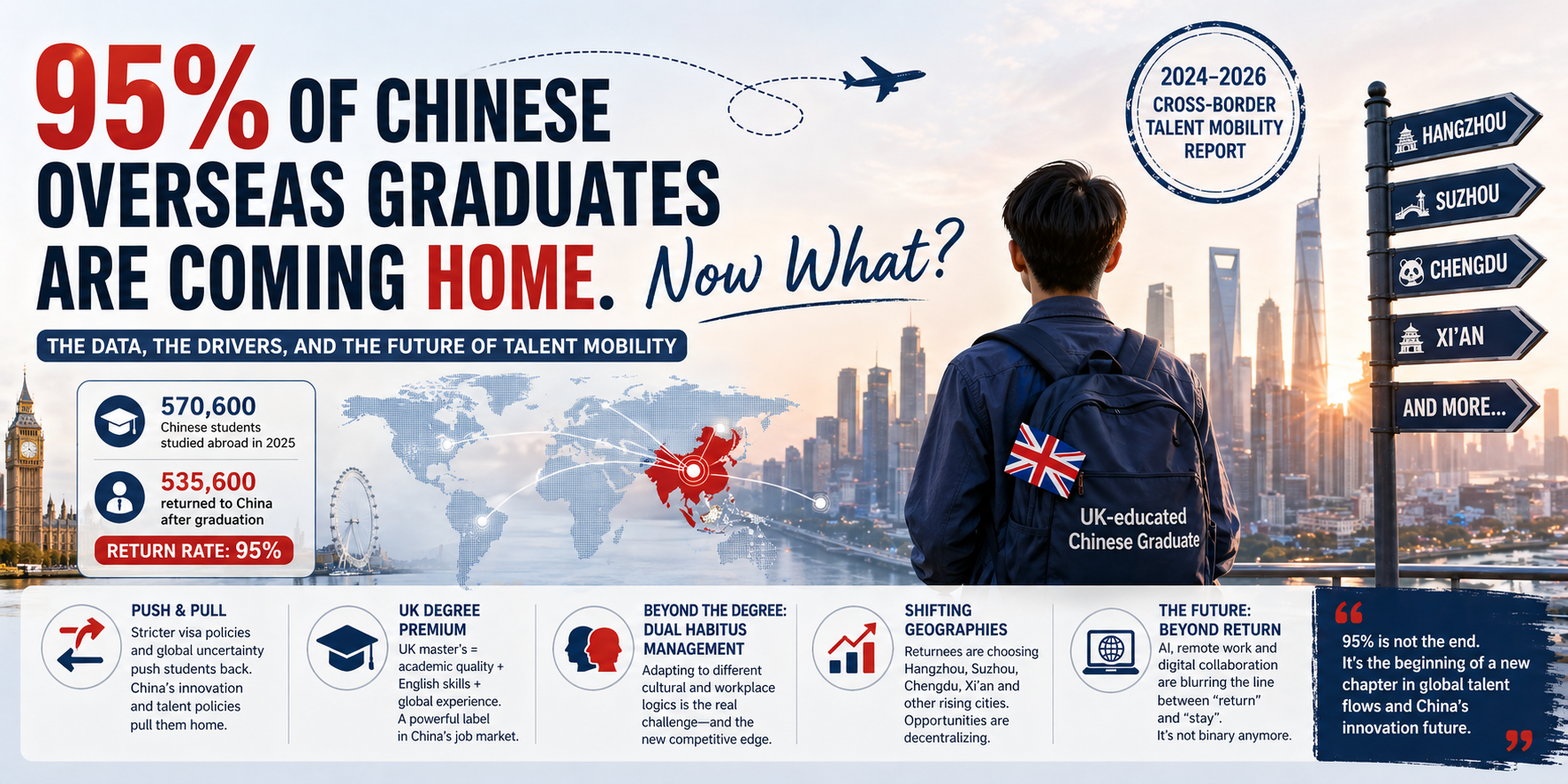
95% of Chinese Overseas Graduates Are Coming Home. Now What?
Let me start with a number that has been stuck in my head since early 2026 — China's overseas graduate return rate hit 95% for the first time.
In 2025, roughly 570,600 Chinese students were studying abroad, and about 535,600 of them chose to go back to China after graduation. That's an 8.2% increase from 2024 (495,000 returnees) and a 24% jump from 2023.[1][2]
I stared at this number longer than I expected.
Not because it's wrong — but because it connects to a larger trend I've been tracking as someone who researches transnational migration in the age of AI. Here's the tension that keeps me up at night: technology is dissolving borders by the day, while people are accelerating their return to the nation-state. These two arrows are pointing in opposite directions. How do you make sense of that?
I. The numbers tell a story, not just a statistic
Let's be clear about what this "95%" actually means.
The figure comes from China's Ministry of Education 2025 statistics.[3] The core metric: students who completed their overseas degrees and explicitly chose to return to China for employment or residence. Not everyone currently studying abroad — just those who finished and faced the choice.
The return rate has been climbing steadily since before the pandemic. In 2019 it hovered around 70–80%. COVID pushed it above 85%. By 2025, it stood at 95%.
This happened against a backdrop of shifting visa regimes globally. Several countries tightened restrictions on Chinese students in "sensitive" fields — AI, quantum computing, aerospace. Visa denial rates went up. Post-study work pathways narrowed. The UK, by comparison, remained relatively stable — UCAS data for 2025 showed a record 18,830 Chinese applicants for undergraduate places, up 25% year-on-year.[4][5]
So the 95% is not the result of any single policy. It's a push-and-pull compound effect:
- Push: tightening visa regimes, geopolitical uncertainty, restricted access to sensitive disciplines
- Pull: China's aggressive policy push in AI, advanced manufacturing, biomedicine — the "new quality productive forces" sectors
The push-pull model explains the surface. But the interesting questions are underneath.
II. What does a one-year UK master's degree actually convert into?
Here's a detail worth pausing on.
Among China's 570,000 overseas students in 2025, the UK was the second most popular destination after the US. And it's not just at the master's level anymore — undergraduate applications from China to UK universities surged 25% in a single year. The "UK turn" is cascading down from postgraduate to undergraduate.[6]
Why the UK?
Beyond the obvious (one-year master's, English environment, QS rankings), a few less visible factors stand out from a researcher's perspective:
First, the UK's restrictions on "sensitive" disciplines are relatively moderate. Not that the UK has no scrutiny — but during 2024–2026, the UK's visa environment and academic freedom were perceived by Chinese families as "predictable." When uncertainty is everywhere, predictability becomes a scarce resource in itself.[7]
Second, British universities are actively managing the "return pipeline." In 2025, several UK institutions signed strategic partnerships with China-based returnee employment platforms — offering online job fairs, CV workshops, and employer networking events in Shanghai and other hubs. Tencent, SF Express, Midea, and Johnson & Johnson all participated. These universities aren't just selling education anymore — they're selling a career pathway that closes the loop in China.[8][9]
Third — and this is the part I find most fascinating — about 80–85% of Chinese graduates from the UK enter what you might call a "symbolic capital conversion" process.
This is Bourdieu's language, but let me translate: a UK master's degree in the eyes of Chinese employers is not simply "a master's degree." "UK master's + English proficiency + international project experience" bundles into a recognizable label — one that commands a higher starting salary and a faster promotion track.[10][11]
But here's the thing — this conversion is not automatic.
III. Bourdieu got it half right. The other half is messier.
A 2024 study examined Chinese students in UK higher education through a Bourdieu-informed lens.[12] The finding that struck me: the first shock these students encounter isn't language — it's academic culture shock.
Think about what it means. You're in a UK master's program. Your supervisor doesn't give you the right answer — she asks you to critique, to argue, to debate with classmates from a dozen different countries. You adapt. Your "academic habitus" gets reshaped.
Then you go back to China.
Back home, you have to readjust to a workplace culture that is more hierarchical, more performance-driven, with a different set of communication rules. The two "fields" operate on conflicting logics. The habitus you painstakingly built in the UK? It's not always an advantage. Sometimes it makes you look awkward.
It's like spending a year learning to walk in a completely different way, then returning to your original path — and finding that the new gait makes you stumble.
Bourdieu's capital theory explains the first half — the accumulation and conversion of capital. But the second half — what I'd call "dual habitus management" — the ability to switch fluidly between two field logics — that's something each individual has to figure out on their own.
Let me make a blunt judgment:
The "returnee premium" is shrinking.
Not because there are too many returnees — but because the labor market is getting more discriminating. Employers no longer pay for the fact that "you studied abroad." They pay for the ability to solve a problem from two cultural vantage points at once. These two things are very different.
IV. From tier-1 to tier-2: are returnees being pushed or pulled?
A 2026 official report flagged another trend that stopped me: returnees' geographic distribution is shifting.
More overseas graduates are choosing Hangzhou, Suzhou, Chengdu, and Xi'an over Beijing, Shanghai, Guangzhou, and Shenzhen.[13]
The obvious explanation is "tier-1 city housing prices are too high" — and that's true, but it's only the surface layer. Let me unpack it:
Surface: Cost of living and competition density in tier-1 cities are genuinely crushing for fresh graduates. This is conventional wisdom.
Middle layer: Local government talent policies are working. Hangzhou's settlement bonuses for returnees, Suzhou's rental subsidies, Chengdu's startup support, Xi'an's full-package talent introduction programs — these are real policies producing real effects. China's talent competition has devolved to the city level, and the results are visible.[13-1]
Deeper layer: The geographic distribution of AI and advanced manufacturing industries has broken the old narrative that "good jobs only exist in Beijing and Shanghai." Hangzhou has Alibaba and a growing AI cluster. Suzhou has an advanced manufacturing base. Chengdu has a gaming and digital entertainment ecosystem. As industries decentralize, talent follows.
Is this a good thing? I think so. A healthy talent ecosystem shouldn't have a single center — it needs multiple nodes.
V. Three judgments (clearly marked, you can disagree)
Everything above was grounded in data. What follows is my reading of it — not facts, but informed judgment.
Judgment one: 95% is the new normal, but not the endpoint.
The 2025 figure was achieved under a specific policy configuration — external tightening + internal incentives. If either vector shifts, the number will move. What I care more about is the composition of the return flow: how many returnees land in high-value AI and advanced manufacturing roles versus ordinary service-sector jobs? That distribution tells a more meaningful story than the aggregate.
Judgment two: UK-educated Chinese graduates are becoming "bridging agents," not just "returnees."
This is not speculation. The 2025 partnership model between UK universities and Chinese companies shows that Chinese graduates of UK institutions are no longer simply "coming back to find a job in China" — they're playing intermediary roles in cross-border value chains. International trade, cross-border investment, technology transfer — these domains naturally demand people who understand both cultural systems.[9-1][14]
Judgment three: AI and digital technology are dissolving the very concept of "returning."
This is the direction I personally find most compelling. When remote work, digital nomadism, and AI-powered cross-language collaboration become viable, the binary of "return" versus "stay" starts to break down. A person could be based in Chengdu, working remotely for a London company, while serving clients in Shenzhen. Is that a returnee? A transnational worker? Something else entirely?
There's no good answer to this question yet. That's why I keep following it.
VI. A closing observation
If you've read this far, let me share something I've learned from years of tracking AI and migration.
Borders haven't been erased. They've just changed form.
Technology is dissolving the boundaries of information flow. But when it comes to human bodies, human visas, human education pathways, human employment choices — borders remain stubbornly real. They're just redrawing themselves in more subtle ways, sorting people into categories that don't always make sense.
The young people who spent a year earning a UK master's degree and then boarded a flight back to China — every one of them is negotiating this tension by hand. Figuring out, in real time, how to find their place between two sets of rules.
That may tell us more than any grand theory ever could.
This article is based on publicly available data and research reports from 2024–2026. The opinions expressed in Section V are personal judgments and do not represent any institutional position. For the most current data, please refer to official sources.
Sources
-
ICEF Monitor. (2026). Inbound, outbound and transnational: The landscape for international education in China continues to evolve. https://monitor.icef.com/2026/03/inbound-outbound-and-transnational-the-landscape-for-international-education-in-china-continues-to-evolve/↩︎
-
China Daily. (2026). More overseas Chinese grads return as 'brain gain' powers future home-grown frontiers. https://www.chinadaily.com.cn/a/202602/11/WS698bc411a310d6866eb38928.html↩︎
-
Global Times. (2026). China ramps up efforts to attract top overseas talent. https://www.globaltimes.cn/page/202604/1358629.shtml↩︎
-
Times Higher Education. (2025). Chinese applicants could increase further if UK shows stability. https://www.timeshighereducation.com/news/chinese-applicants-could-increase-further-if-uk-shows-stability↩︎
-
UCAS. (2025). UCAS undergraduate application data 2025 cycle.↩︎
-
BUILA. (2025). China's outbound student drop signals maturing market. https://www.buila.ac.uk/articles/chinas-outbound-student-drop-signals-maturing-market↩︎
-
Dan Yu. (2025). Chinese overseas mobility 2025: The end of British and American dominance? LinkedIn. https://www.linkedin.com/pulse/chinese-overseas-mobility-2025-end-british-american-dominance-dan-yu-vpa8c↩︎
-
CBBC. (2025). Bridging talent across borders: Recap of CBBC's Access Talent initiative. https://www.cbbc.org/news-insights/bridging-talent-across-borders-recap-cbbcs-access-talent-initiative↩︎
-
Skoobuzz. (2025). UK universities, China graduate employability 2025. https://skoobuzz.com/news/uk-universities-china-graduate-employability-2025↩︎↩︎
-
Prospects/Luminate. (2025). Outcomes for UK-educated Chinese and Hong Kong students. https://luminate.prospects.ac.uk/outcomes-for-uk-educated-chinese-and-hong-kong-students↩︎
-
LinkedIn/Nicol, L. (2025). 495,000 overseas students return to China. https://www.linkedin.com/posts/louisenicol_495000-overseas-students-return-to-china-activity-7405927059262517248-hSyK↩︎
-
WEPUB/TSSEHR. (2024). Bourdieu-informed study on Chinese students in UK higher education. https://wepub.org/index.php/TSSEHR/article/view/1432↩︎
-
China Daily. (2025). Returnees' employment, entrepreneurship services upgraded. https://www.chinadaily.com.cn/a/202604/10/WS69d913dfa310d6866eb42cd1.html↩︎↩︎
-
LinkedIn/Amanda Tao. (2026). Asia's takeover, UK's mobility reset, plus how to recruit? https://www.linkedin.com/posts/amanda-tao-76859635_one-detail-that-stood-out-to-me-this-week-activity-7419744976873631745-W1Zm↩︎
