A UK Degree Isn't Losing Its Value — It Just Stopped Glowing Automatically
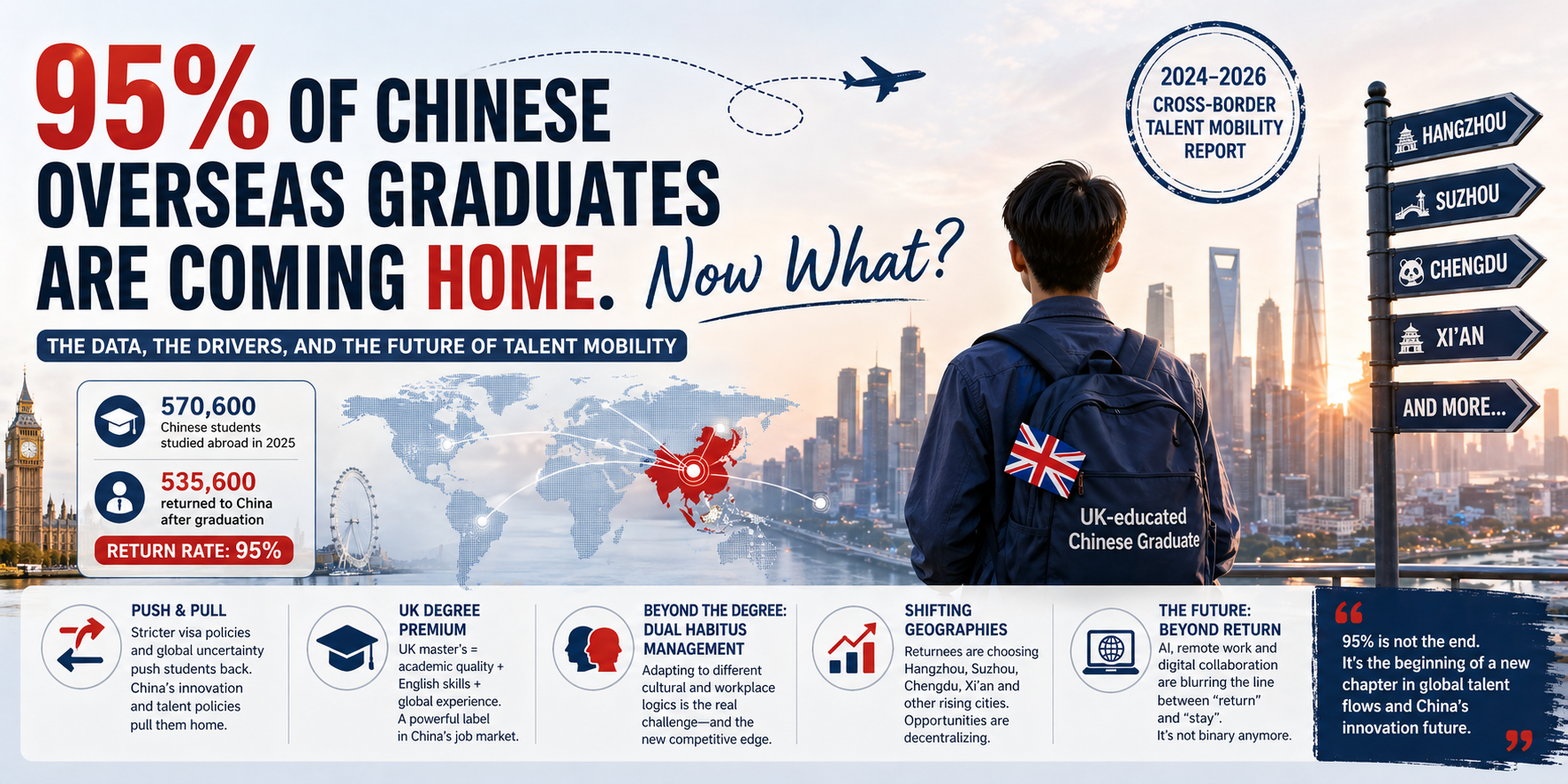
Here's a number that keeps coming back to me: 95% of Chinese students who study in the UK return to China after graduation.
I stared at this number longer than I expected. Every year, tens of thousands of Chinese graduates fly back from British universities. Then what? Scroll through Chinese social media and you'll find a whole vocabulary around this experience — "haigui贬值" (returnee devaluation), "haifei" (overseas returning wastes). People share stories on Douban and Xiaohongshu about months of job hunting with no offers, or landing offers at salaries that make the cost of their degree feel absurd.
The narrative is clear: the overseas degree halo has shattered.
But after digging through a stack of 2024-2025 studies, I'm not so sure that's the full picture.
The Halo Didn't Shatter. It Became Conditional.
Let's start with what the data actually says — because it's not "everything is fine," but it's also not "everything has collapsed."
Quantitative research based on the China Household Finance Survey shows that returnees with postgraduate degrees still earn more and land better positions than their domestic counterparts. They're more concentrated in foreign-invested enterprises and high-income sectors. But here's the catch: at the undergraduate level, the income gap between returnees and graduates from top Chinese universities is essentially gone.[3][8]
What this tells me is that "where you studied, what you studied, and at what level" matters far more than the simple fact of having studied abroad.
In other words: a UK degree hasn't stopped being valuable — it's stopped being automatically valuable.
One way to think about this is through Bourdieu's framework, which a 2025 study of 100 Chinese returnees applied directly. Their conclusion: employability isn't a fixed property of a diploma. It's a "positional capital" that only comes alive when it's combined with the right industry skills, local experience, social networks, and digital presence — all within a specific context.[1][9]
Let me translate that into plain English — whether your UK degree "works" depends on where you land, who you know, and what else you bring to the table.
Piece One: The Capital Portfolio
Employers see UK graduates as having clear strengths and equally clear gaps.
A 2025 interview study with Chinese employers and UK master's alumni found that employers consistently value British degrees for English proficiency, adaptability, time management, and cross-cultural communication. But the same study identified specific weak spots: Chinese-language academic writing, local industry knowledge, digital skills, and — crucially — local professional networks.[11]
This explains the puzzle. Why do two people with identical UK master's degrees have completely different career trajectories after returning? It's not the degree that's different — it's the rest of their capital portfolio.
The Bourdieu-informed study I mentioned earlier tracked 100 returnees and found that their employability was deeply situational. In foreign-invested companies, a UK degree plus English fluency and cross-cultural exposure is a clear asset. In SOEs (state-owned enterprises) or government-adjacent roles, lacking domestic internships, local connections, and "institutional experience" makes that same degree a much weaker signal.[9][14]
The degree is a ticket. What matters is the rest of your bag.
Piece Two: Cities Have Different Conversion Rates
Let me ask a simple question: if a UK degree's value is situational, what's the biggest situational variable?
The answer, based on what I've been reading, is the city you end up in.
In first-tier cities like Beijing and Shanghai, a UK degree is one credential among many. Tens of thousands of graduates from China's top universities — Tsinghua, Peking, Fudan, Shanghai Jiao Tong — are applying for the same roles. The overseas degree gets you into the first round, but by the final interview, it's all down to internship experience, project portfolios, and personal referrals. A study on Shanghai's hukou policy even suggests that employers are becoming more cautious about returnees, worrying about their "potential mobility" in a system where hukou precarity makes long-term commitment uncertain.[14]
But look at second-tier cities and the picture flips.
Hangzhou, Chengdu, Wuhan, Xi'an — these cities are actively competing for returnees. National and local policies have been rolling out: relaxed hukou requirements for returnees, housing and relocation subsidies, dedicated entrepreneurship parks with tax breaks, and "talent shortage" programmes in AI, biotech, and next-gen IT that specifically target overseas graduates.[16]
Same UK degree. In Beijing, it's a line on a resume. In Hangzhou, it's a key to policy benefits.
This kind of city-level capital conversion gradient is invisible in macro-level statistics. But for a returnee deciding where to land, it's arguably the most important factor — and it's determined the moment you pick up a suitcase and choose a city.
Piece Three: Algorithms Are Also Rating Your Degree
Here's a dimension I didn't expect to find so much traction on — digital space.
Social media has fundamentally changed how "the returnee experience" is narrated and consumed. A 2024 report documented the rise of "haifei" (overseas wastes) as a self-identifier on Chinese platforms. Groups on Douban and Xiaohongshu share job search frustrations, salary disappointments, and the sense of being squeezed between high expectations and a tight labour market. The returnee is no longer imagined as a high-flying elite returning to a six-figure salary — they're a young person with the same anxieties as everyone else.[5]
What surprised me more was the role of hiring platforms.
On platforms like BOSS Zhipin and LinkedIn, an overseas degree is reduced to a few fields: university name, major, dates. These fields feed into recommendation algorithms. For premium positions, "overseas名校" (prestigious overseas university) boosts visibility. For more routine roles, the same field might lower your ranking — flagged as "likely has high salary expectations" or "stability concerns."[8][11]
This algorithmic credential certification is crude. It rarely distinguishes between specific programmes, quality of experience, or actual capability. But it has real consequences — it reproduces stereotypes at scale, filtering returnees in and out of opportunities based on a handful of data points.
Your UK degree, in this system, becomes a tag that an algorithm sorts, weights, and sometimes filters out.
So let's return to the original question: Is a UK degree still worth it?
Yes — but not as an automatic passport.
At the postgraduate level and in specific industries, it still translates into better income, career advancement, and transnational mobility. But this advantage is deeply contingent on city structure, industry fit, local experience, and digital visibility. It's a capital that has to be continuously proven and converted — not a badge you wear for life.
The feeling of "haigui贬值" captures something real: a tight labour market, widespread youth precarity, and social media's power to amplify individual failure into a collective narrative. But it also flattens a landscape that is much more granular and situational than the headlines suggest.
The question that keeps me thinking isn't "Are UK degrees losing value?"
It's this:
In which cities, which industries, and on which digital platforms can a returnee actually convert their UK education — plus everything else they bring — into meaningful opportunity?
There's no single answer. But it's a much better question than "is it worth it." Because it's one you can act on.
*This article draws on multiple 2024-2025 studies: China Household Finance Survey data[3][8], employer and alumni interview research[11], Bourdieu-framework returnee employability studies[2][9], Shanghai hukou policy analysis[14], second-tier city talent policies[16], and social media returnee discourse[5][17]. *